Thursday, 10 March 2016

OUGD505 - Studio Brief 2 - Survey Results

After having the initial project proposal I found people's views on animal cruelty in farming really interesting so I decided to take it a bit further and do a complete survey to try and figure out people's views.

What words come to mind when you think of a farm?

Animals, fences, tractors
3/8/2016 8:19 PM View respondent's answers
Process, produce,
3/8/2016 7:04 AM View respondent's answers
animals, mud
3/7/2016 11:04 PM View respondent's answers
fresh, open, traditional, mucky
3/7/2016 7:05 PM View respondent's answers
No idea
3/7/2016 5:05 PM View respondent's answers
Cow and chicken
3/7/2016 11:18 AM View respondent's answers
animals, mud, dirt, tractor
3/7/2016 8:45 AM View respondent's answers
Animals, food, muck, pitchfork
3/7/2016 1:22 AM View respondent's answers
Milking cows
3/6/2016 11:37 PM View respondent's answers
Fresh produce
3/6/2016 10:29 PM View respondent's answers
Animals
3/6/2016 10:18 PM View respondent's answers
Cruelty, small confined spaces, abuse.
3/6/2016 9:26 PM View respondent's answers
Hard, agriculture, simple, livestock
3/6/2016 8:45 PM View respondent's answers
barn, smells, farmer, tractor, produce
3/6/2016 8:17 PM View respondent's answers
animals, mud, dirt, tractor
3/6/2016 7:56 PM View respondent's answers
Animals
3/6/2016 7:54 PM View respondent's answers
Animals, green, smell
3/6/2016 7:51 PM View respondent's answers
Dairy, sheep, cow, tractor, produce
3/6/2016 7:02 PM View respondent's answers
Cows
3/6/2016 6:58 PM View respondent's answers
Produce, use of land, crops, tractors
3/6/2016 6:57 PM View respondent's answers
Chickens, grass, cow poo, green, rickety buildings, tractors, ponds
3/6/2016 6:48 PM View respondent's answers


The two other responses stated that they don't buy eggs.


Other Responses:
More than I'd like to know
3/8/2016 7:04 AM View respondent's answers
A considerable amount.
3/7/2016 1:22 AM View respondent's answers


Is the subject of cruelty in farming “taboo” in today’s society? If so why do you think it is not talked about very often?

Yes people get offended by me just mentioning that I don't eat meat, if I were to actually discuss my views I'd be labelled as preachy and rude so I don't dare bring it up
3/8/2016 8:19 PM View respondent's answers
Presumably because we're all complicit by consumption
3/8/2016 7:04 AM View respondent's answers
no - it is not taboo.
3/7/2016 11:04 PM View respondent's answers
I think people either don't have time to worry or just want to avoid feeling guilty for consuming animal products, or they literally just don't care about the well being of other creatures.
3/7/2016 7:05 PM View respondent's answers
Who wants to talk about it?
3/7/2016 5:05 PM View respondent's answers
Money shuts people up
3/7/2016 11:18 AM View respondent's answers
People think they have a right to eat meat and use animals for their ease of life
3/7/2016 8:45 AM View respondent's answers
No, people just choose to ignore it because they are ignorant and have "more important" things to worry about such as Instagramming themselves in Nando's.
3/7/2016 1:22 AM View respondent's answers
Lack of knowledge
3/6/2016 11:37 PM View respondent's answers
Not enough people care strongly enough
3/6/2016 10:29 PM View respondent's answers
Because people would rather not know what they are doing I guess.
3/6/2016 10:18 PM View respondent's answers
Because people don't want to come to terms with how animals may be abused during the process, we are very disconnected in the mind from our food sources.
3/6/2016 9:26 PM View respondent's answers
"Cruelty" in farming seems to be a necessity due high populations, I dont think the subject is taboo, more that people are apathetic in general so they don't talk about anything...
3/6/2016 8:45 PM View respondent's answers
Yes because people dont want to think about it - it is seen as normal to eat meat/dairy/eggs. To oppose it is deemed as an unpopular "opinion"
3/6/2016 8:17 PM View respondent's answers
People think they have a right to eat meat and use animals for their ease of life
3/6/2016 7:56 PM View respondent's answers
Because it is uncomfortable
3/6/2016 7:54 PM View respondent's answers
So it can be ignored.
3/6/2016 7:51 PM View respondent's answers
It's not talked about because people don't want to pay more for their food, or change their eating habits. Today's society revolves too heavily around the money and not how healthy they are or how well animals are treated.
3/6/2016 7:02 PM View respondent's answers
because when people try to talk about cruelty in farming theyre made fun of. For example, the "how do you know someone is vegan" joke. trying to change someones dietary choices through education is considered invasive and judgmental when it should be a welcome and open discussion.
3/6/2016 6:58 PM View respondent's answers
I think people don't like to talk/think about it because they're happy with the way they live. If someone is comfortable wearing clothes produced in a sweatshop then they are comfortable with cruelty in farming.
3/6/2016 6:57 PM View respondent's answers
I think a little bit yeah, meat eaters don't like to know or just aren't interested in where they get there meat from sometimes, and with the stereotype vegetarian or vegan they'd rather not get into conversation about it. Also I think we know what happens to our animal products roughly, but just don't want to know all the details because we like what we eat and probably wouldn't change if we did.
3/6/2016 6:48 PM View respondent's answers


If you have any other comments about animal cruelty and or farming methods concerning the meat and dairy industry please write it below.


I really want to go vegan but I'm going to have to wait until I leave home as my parents have made it clear they would be very upset
3/8/2016 8:19 PM View respondent's answers
Transportation of animals long distances is something that concerns me.
3/7/2016 11:04 PM View respondent's answers
I think that methods were kinder in other times, and we industrialised and depersonalised and thought about profit and output and forgot about kindness and quality.
3/7/2016 8:45 AM View respondent's answers
I feel sorry for the animals only purpose being to feed us, but bacon pancaaakes, makin bacon pancaaaakes.
3/7/2016 1:22 AM View respondent's answers
dont like intensive cruel farming
3/6/2016 11:37 PM View respondent's answers
I think that methods were kinder in other times, and we industrialised and depersonalised and thought about profit and output and forgot about kindness and quality.
3/6/2016 7:56 PM View respondent's answers
This issue goes extremely deep and I feel like animal cruelty is only one of many reasons that traditional farming methods are outdated. For example, the environmental impact that keeping livestock causes - methane production etc.
3/6/2016 6:57 PM View respondent's answers
I think farming methods should definitely be improved, and it is an issue, but at the same time i won't stop eating meat or dairy because they're bad
3/6/2016 6:48 PM View respondent's answers


I wish that I had got some more results for this survey but as a whole I'm really interested by what people have said. Especially for the more in depth questions where it required people to type. People seem to have this view of farms as these idyllic places where animals live and don't really know the reality of it. I also found it quite interesting how mixed some of the answers were, for example with the local/organic produce question, there was a mix. If students answered this I can understand the reasoning behind buying cheaper produce. Perhaps I should have asked the age range and gender of people answering so I knew who to aim a campaign at. 

Also the views of why people believe the subject is taboo is really interesting as well. It helps me gage what the general consensus is. I will have a thorough read through of this and try and make sense of how I can create a campaign to possibly help change people's minds.


Thursday, 3 March 2016

OUGD505 - Studio Brief 2 - Animal Cruelty charities


While researching further into current campaigns about animal cruelty in farming I came across this page full of relevant charities. These charities are a lot less known that others like Peta so maybe I could support one of them through a design campaign to get their name out there.

http://www.animalcharityevaluators.org/recommendations/top-charities/

Wednesday, 10 February 2016

OUGD505 - Studio Brief 1 - Banknote Research

Dollar Redesign by Mucho, London.


We changed the format from horizontal to vertical: a logical change as research revealed that people tend to handle notes vertically, and all machines accept notes vertically. We retained the width of the existing notes, but changed their length. The $1 bill became the shortest and $100 the longest, making it easier for people – especially the visually impaired – to distinguish between notes. Using different colors also gave each note a stronger individual identity. Imagery was selected to reflect the value of each note, with an educational element aimed at Americans and visitors alike. Each denomination features a black and white image of a particular aspect of American history or culture

I particularly like how these notes have a vertical format rather than a horizontal one. I feel like this has a more contemporary vibe to the notes as it switches up the norm. Also the use of the vivid colours adds to the modern feel rather than having the muted and dark tones that are usually used on bank notes. Additionally the use of photographs instead of etched illustrations brings the notes up to date. However all this simplification does mean that the notes themselves would probably be quite easy to reproduce which means that they aren't very secure. 


Over in the US designer Travis Purrington has created his own take on the US currency which is similarly visually appealing. OK it’s unlikely to take the place of the founding fathers any time soon (actually between Apple Pay, PayPal latest work and thing like https://onlycoin.com/ it may be that currency will become used less and less), but nevertheless it’s an interesting piece of visual design.
Travis actually states “Inspired by the Swiss Franc’s (CHF) ambitious redesign process (the currency is thoroughly redesigned every 20 years by way of contest) The goal was to develop a similar updated iconographic system better representing the advancements and culture within the American society.” but it seemed like a nice excuse to showcase the Norwegian banknote design.
Once again these are very contemporary designs for bank notes. I particularly like the use of scientific discoveries rather than the history of the country as I feel like almost every banknote is based around historical figures. So bringing it up to date with technology and science is a way to make it modern. The use of geometric shapes within each design also adds to this and almost gives a screen like quality to the notes making them look like pixels. 


The famous re-design of the Norwegian bank notes has been part of much discussion in the design world. The abstract use of shapes, silhouettes and colours really adds together to make really interesting images for the notes. Mixed with the photographic elements on the back they feel very relevant to the country that they were created for. 


Monday, 8 February 2016

OUGD505 - Studio Brief 1 - Digital Development


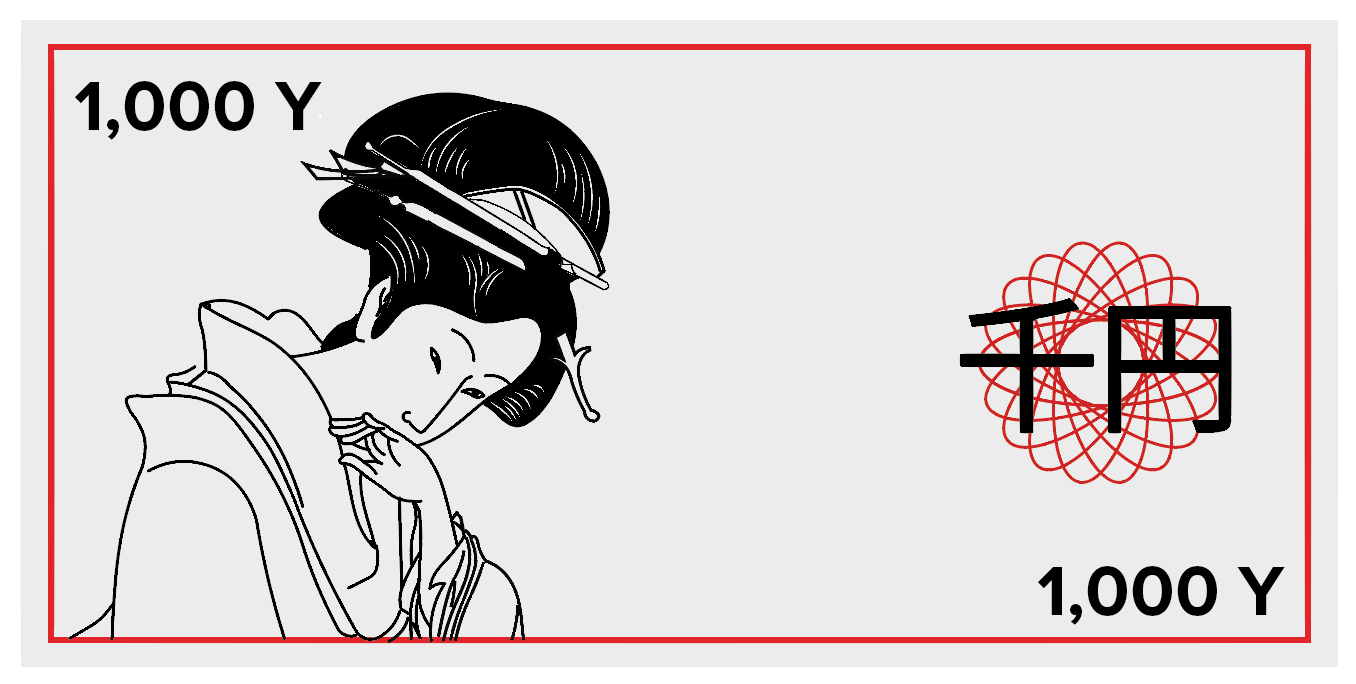
The first note that I started to try out was the tradition wood block prints one. I found a print and vectorised it while trying to keep the style as close to the original as possible. To make the notes more up to date I wanted to use a limited colour palette that represents Japan so I chose grey, red and black. At the moment the note feels very empty so I might add some patterns in order to make it more secure and less forge-able.


I tried various patterns from a halftone to using the letter equivalents of the Japanese for the amount on the note. Additionally, inspired by the dollar redesign I tried out making the bank note vertical rather than horizontal to twist up the norm. I like this orientation of the note because I feel like it draws the eye down to the illustration rather than drawing your eye across the note to nothing. 


I experimented more with different uses of the text, inspired by the famous rising sun image of Japan. Although the strong use of red on these designs is a bit too overpowering. I'm not sure how all these fine details will come out if I screen print it too, they might block easily when I screen print. 

Sunday, 7 February 2016

OUGD505 - Study Task 1 - Appropriation and Subversion

Today we had a task about appropriation and subversion, about how some artists and designers use and abuse other people's artwork in order to present a completely different message.

I found this really interesting to see how people can put across certain political messages. Some of the artists in particular from the presentation caught my eye and gave me some ideas on how I could portray my campaign.

Barbara Kruger


‘We Go To The Museum’ by Miriam Elia (2014)


I based the study task itself on the issue that I have picked for studio brief 2 - Animal cruelty in farming and the general taboo about whether or not we as humans should eat meat. I created two designs, one text and image and the other just text. I feel like the just text poster is more effective as the left over red paper that I used as a background almost looks like knife wounds, consistent with some slaughtering methods. Also the mis-match of the type cut out from magazine portrays the message with a strong and powerful yet ransom note like feel.


Friday, 5 February 2016

OUGD505 - Studio Brief 1 - Initial Sketches

I started to sketch out some rough ideas for the Yen bank notes. At first I was thinking of more traditional ideas that involved traditional Japanese art and culture. For example I thought about using famous Japanese wood block prints like the wave and maybe one of a geisha as well. To add to the quality I thought about embossing the kanji characters. I think that these would work well with a simple colour palette however I am unsure on how easy to reproduce they would be. I would have to add a lot of detail in order to make them hard to forge. 


The next idea that I had was to use the Japanese elements through landscapes and buildings. For example here I have used a cherry blossom tree for the element of earth and a koi fish for the element of water. I quite like this idea because the elements are something that are revered in Japanese culture so I feel that they would be relevant. Also I feel like there is more room to modernise the note design with this concept rather than the traditional prints which may come out similar to the current note designs. 


Next I thought about some different, more abstract ideas to relate to origami where I could emboss a sort of folded pattern onto the note designs to represent the traditional Japanese art. However I don't know how I would incorporate colours into this and what method of printing to use. Though the patterns created here would be effective I feel like it wouldn't be enough to fill a banknote and it would feel empty. 

My other idea was slightly "out there" I thought that I could use popular Japanese culture today by having anime characters on the bank notes. Or even show some of the many interesting and unique sub cultures that Japan holds today. While this idea would be interesting to explore I feel that it might not suit the sensible and quiet nature of the Japanese people. 

However I will try out most of these ideas digitally to see how they would work with colour and proper type.

Saturday, 30 January 2016

OUGD505 - Studio Brief 2 - Initial Ideas and Research

As soon as we got briefed for Studio brief 2 I knew what social/environmental issue I wanted to take forward to react to and that was animal cruelty in farming. I have been a vegetarian for just over 9 years now and I am passionate about caring for and treating animals equally to humans. I am very aware that most of society turns a blind eye to how meat is actually produced and what the animals have to suffer through in order to feed our species when there is no problem with a plant based diet. We have many charities that help to stop animal cruelty such as the RSPCA, WWF and the Blue Cross yet none seem to remotely be concerned about the cruelty happening just to put cheap food in our shopping baskets. So I know that I want to focus on the plight of cattle in the farming industry rather than animal cruelty as a whole because of how little it is publicised. So I thought that I should research some of the facts about this cruelty.


ANIMAL CRUELTY IN FARMING

CHICKENS

Such a high number of chickens are killed: over 900 million chickens were slaughtered in the UK during 2013 (Defra 2014). This figure does not include the hundreds of millions of male chicks who are gassed or crushed to death simply because they can’t lay eggs for the industry to sell.


Chickens for meat

Broiler chickens have been manipulatively breed to grow much quicker than they would do naturally. To increase the industry’s profitability, chickens are now reared to reach slaughter weight in a much shorter time. If humans grew at the same rate as broiler chickens, we’d weigh 25 stone at age two. As Dr Toby Knowles from the UK’s Bristol University Division of Food Animal Science states:

‘In the past 50 years, broiler growth rates have increased by over 300 per cent from 25g per day to 100g per day’.

This unnatural rate of fattening puts increasing pressure on the chickens’ legs. Many of them are unable to support their own body weight and eventually collapse. Hock burns (small areas of dark discolouration around the knee joints) are evidence of this suffering. As the birds struggle to stand, they will often squat to the ground where high concentrations of ammonia (from their faeces) will burn the chickens’ legs and breast.

Egg Laying Hens

50% of laying hens in the UK are kept in cages. These chickens have very little space (not much larger than a single sheet of A4 paper) and spend the majority of their lives inside. In such small spaces, hens are unable to engage in basic natural behaviours like walking, nesting, spreading their wings, dust bathing, or foraging for food. The system uses artificial lighting, which is set for prolonged periods, to encourage hens to lay more.

This overcrowding allows disease to spread quickly and causes other serious welfare issues for the chickens. In these close confinements their bodies are often crushed as the chickens compete for space. Unable to escape, stressed, many chickens suffer from severe feather loss and foot deformities from standing on wire cage floors.

AnimalNatural lifespan (on average)Age at which they are typically killed
Broiler chicken7 years40-50 days old
Male chicks7 years1 day old
Layer hens7 years18 months old
COWS

According to the dairy industry, there are around 1.8 million dairy cows on the 14,550 dairy farms across the UK, which equates to 2 million dairy calves born every year. Statistics from DEFRA put the UK’s beef herd at approximately 1.6 million. In total, this equates to 3.4 million cows being raised for dairy and beef production in the UK alone, and does not factor in the estimated 2 million calves born as a result of dairy production.

Milk Production

Like all female mammals, to produce milk, a cow must give birth. And like human females, a cow’s pregnancy lasts nine months. A dairy cow has her first calf at around 18 months old. Typically, this calf is taken away from her within hours of birth. This separation is traumatic for both her and her baby. Cows will often bellow for prolonged periods to be reunited with their young. Mother cows will walk back and forth rapidly in an effort to reconnect, often for several days.

To ensure a constant supply of milk, a cow will suffer this same process of pregnancy, and separation several times in her life. She is caught in this cycle for as long as she can produce enough milk to be deemed ‘profitable’. A dairy cow is typically artificially inseminated every 13 months, meaning she will give birth to a calf nearly every year. While a cow would naturally live 15-20 years, because of the health toll of constant pregnancies and milk production, the lifespan of a dairy cow is only five to seven years.

With so many cows having baby after baby to ensure a constant supply of milk, the dairy industry produces millions of ‘surplus’ calves. Female calves, as soon as they are old enough, will become milk-producing machines just like their mothers.

Male Calves

Since they do not produce milk, male calves (also known as bull calves) are of no use to the dairy farmer, and fetch very low prices at auction. The males of dairy-producing breeds do not grow as large as breeds raised for beef, so these calves are often killed at birth, sold for low-quality meat, or raised for veal.

Some countries still use veal crates to confine dairy calves. Because veal is prized for its pale, tender texture, baby calves are confined to very small pens, hutches, or crates to restrict their movement, and fed nutrient-deficient diets. Veal crates are so patently cruel they have been banned in the entire European Union and at least seven U.S. states. Veal calves, whether in crates or pens, are slaughtered at around six months.

Cows for beef

Globally, more than 290 million cows are slaughtered every year. The beef industry is a large sector of agriculture within the UK – Scotland primarily, with the second largest beef herd in Europe, after France. During the first week of their lives calves are often disbudded and castrated. Then they are fed on cereals in ‘fattening sheds’, where numbers can reach as high as 8,000, before they are sent to slaughter at the early age of 11 – 12 months.

Whether they are raised for beef or dairy, all cows end up at the slaughterhouse, and experience the same horrors.

Once at the slaughterhouse, most cows in the UK are stunned with a pistol-like captive bolt gun to the brain, then shackled, bled, disembowelled, and skinned. However, due to the high speed of the production, the law stating cows must be rendered unconscious or insensible to pain before being killed is routinely ignored as cows and unskilled workers struggle and many animals have their throats cut and their skin removed while fully conscious.