Saturday, 14 November 2015

OUGD504 - Studio Brief 4 - The Brief


SEASICK STEVE

Seasick Steve is a unique performer - having his career breakthrough at the age of 65 on Jools Holland on New Years Eve. He is an American blues musician. He plays mostly personalised guitars, and sings, usually about his early life doing casual work. I really like the fact that all of his instruments have stories and most of them are made by him for certain songs.

His wikipedia page has a list of all of his most used instruments. I find the materials that he has used to create them and to make the unique sounds so interesting.

Guitars

The Three-String Trance Wonder

This is a normal guitar that resembles a GHI Guitar made in Japan in the 1960s. It has an old Harmony pickup added with duct tape, and is tuned to G, A and B using an E string in the A position, a D in the G position and a G in the B position. At his gigs, he often tells the story that he bought it for US$75 in this condition in Como, Mississippi, from a man named Sherman, who later told him he only paid US$25 for it the day before. Wold vowed never to add another string, and that he would tour the world telling his story of how Sherman ripped him off. All in good fun as Sherman Cooper is a good buddy, who gave him the guitar having had it nailed to the wall as a decoration.  A lot of the time he also adds, while picking up or putting away the guitar, that it is the "...biggest piece of shit in the world, I swear." In a BBC interview Wold claimed that the guitar was found by a friend, just with the three strings on it, and he decided to keep it that way.

Hubcap guitars

When on the TV show Top Gear, presenter Jeremy Clarkson commented that Wold's car history of over 100 cars included a Morris Minor. Wold then presented a four-string guitar that his friend Davey had made out of two old hubcaps from a Minor 1000 joined back-to-back and his wife's broomstick. Wold then played it a little in the episode. Clarkson replied that it was the best use of a Morris Minor he had ever seen.
A similar guitar was made out of Hudson Terraplane hubcaps, one of them given to him by Jack White, referring to "Terraplane Blues" by Robert Johnson.

Other

The Mississippi Drum Machine

A small wooden box that is stomped upon, providing percussion. It is decorated with a Mississippi motorcycle registration plate ("MC33583"), and a small piece of carpet.

Roland CUBE

A Roland CUBE 30 W amplifier placed on a chair to his left and set to the 'tweed' setting.

Fender Bassman

A Fender Bassman amplifier, used at the Pinkpop Festival 2012.

Additionally I found a nice interview with him from Acoustic Magazine:

His website at the moment is quite plain and I feel like it doesn't represent his ethos or personality at all. When I watched him perform he was very humble and charming. It felt like he was telling us a story throughout his performance of his life which was very personal. Also he would explain each of his instruments when he got them out to play.


OUGD504 - Studio Brief 3 - Final Book & Evaluation


During the production of my final book everything seemed to go wrong. With my other mock ups I trimmed each page individually and by hand within the crop marks before I bound them. However with the final I tried to use the guillotine so that I could crop all of the pages at once. This didn't work out at all and ended up misaligning the tracing paper pages with the photos so they no longer lined up. This was incredibly annoying as it meant I had to line up and trim each set of photos and letters down in pairs. This was very time consuming and meant that my final book was a tiny bit smaller than I expected. Also with the final binding of the book I did more stitches because my mock up stitches came a bit loose. Also due to my struggle last time I tied the stitch on the outside and it ended up being a lot tighter which I am happy about. Overall I am really pleased with the final book despite all the difficulties I had while trimming and binding it. 

Generally through out this brief I found book layout quite difficult as I found it hard to develop designs further without coming up with new layouts. However I was overall happy with the results - I like the minimal approach I chose, it pushes me away from my usual style but I think this is good for me. I did struggle with creating the final product due to the misalignment of the tracing paper and the images after I cropped them all in one stack instead of individually. I found the binding method and the actual book binding itself fun to do as I enjoyed the hands on approach - perhaps I can experiment with this to further push my practice. I struggled with blogging in this brief as I was spending a lot of my time doing experiments or trying to get on with the other modules. I used this studio brief to experiment with methods that I have not used before such as  the binding method - I had never attempted a Japanese Stab bind and now I am very confident doing one. I wanted to experiment with foiling too and I managed to test lots of different foils even though the results were rather disappointing it is something that I might pursue in future projects.
I also further pursued my interest in screen printing which I enjoyed a lot. it was good to give myself more of a challenge by doing the cover really small so I had to work on my placement and alignment skills of screen printing. 

Wednesday, 11 November 2015

OUGD504 - Studio Brief 3 - Final Crit

In my final critique I hadn't finished the book yet but I brought my mock up with me as well as the printed pages for my final. My peers said that they liked the Japanese stab binding because it gave the book an added tactile-ness. One thing that was bugging me with my print out was that some of the images where I have added the filter to make the images look like they were taken with a 3mm camera were a bit unclear. I asked the others if they thought so too and they agreed but they said that they liked the effect over all. 

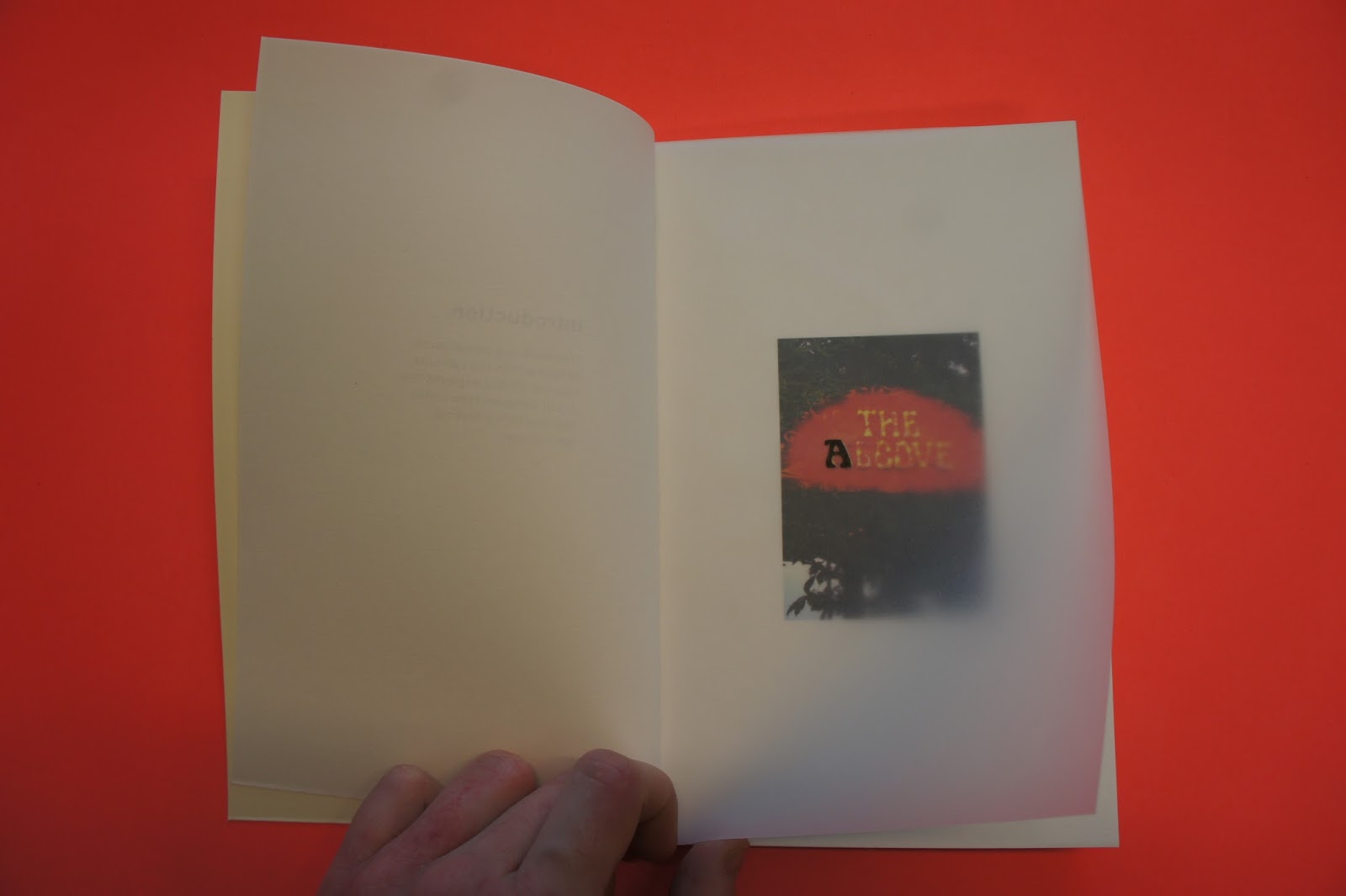
They also commented that the tracing paper gives the book a really nice effect, they said they liked the way that the image and letterforms could be combined and separated with it. Although it does mean that for some of the letter forms you have to line up the tracing paper and the photographs. It was suggested to me to look at www.beccamakingfaces.com to look at more experimental Japanese binds. However I feel like this would take away from the minimalism of the book so far. Also because I had handed round my printed copy that wasn't bound yet I got a bit of feedback on the stock choice. They preferred the stock used on my mock up - it was thinner so that the book could be flicked through. This thicker stock choice would make turning pages difficult - perhaps I could trim the tracing paper inlays down so they can be looked at separately. Or alternatively print on a thinner stock.

OUGD504 - Studio Brief 3 - Production

Below are images of my full mock up with screen printed cover and full colour photographs. The production process was fairly simple for this binding method as I didn't need to worry about pagination. Also the fact that my book's pages were single sided made this even easier. 


The actual binding process was a bit of a pain using the cartridge paper. The last stitch of Japanese binding has to split through the middle of the book and tie off there but I really struggled doing this and found it difficult to put the needle back through the middle. I think for my final bind I will tie it off on the outside as the result of the tying off in the inside loosened my bind. 


The over all alignment on this was really successful - I was worrying that it would go out of place when binding it. 


Also I found the two colour screen print on the front cover really effective at giving the title that 3D look. I am disappointed that I couldn't foil the highlights because of the methods that I wanted to use. But I feel that the white is more subtle - the holographic foiling might have ended up looking really tacky and bringing the quality finish down a bit.

If I were to produce this book commercially it would be quite difficult if I wanted to do a large print run as the only way to do this bind is by hand - there is no machinery that can create it. So this would definitely put the prices up to produce as well as the time scale being a lot longer. Also having a two colour screen printed cover would make it an even more bespoke product and once again make it more expensive to produce. However I think that this adds to the journal concept that I was going for because of how bespoke it is. I know that it is unique and hard to reproduce. 


Monday, 9 November 2015

OUGD504 - Studio Brief 3 - Further Development

This was my first full mock up of the book with my chosen binding method. I also printed it with the tracing paper sections too to see if they would line up properly. The end result was surprisingly effective. After moving over the gutter from the last mock up I thought that there would be problems with the layout that I would need to adjust. However the images seem to be perfectly central so I am pleased with the layout. I also changed the title to be a lot smaller, while also shifting it to the right. I much prefer this size.


After printing this out and binding it, it seems like the finished product. I am pleased with the minimal layout I had chosen and I feel that it works really well for the context of my book. I do feel like it is more personal as well by highlighting the shapes of the letterforms instead of just having them on the other page. I think that this will be my final layout, all I need to do now is get feedback and see if my peers agree. 

Thursday, 5 November 2015

OUGD504 - Studio Brief 3 - Cover Development

I wanted to find a font that represented the freedom and the spirit of the festival to use as my title case within the publication. At first I was going to use a very simple sans serif font to appeal to a younger target audience by making the publication look contemporary. However I feel this would not show the character of a festival so I decided to find something more suitable to the context. 


I started by experimenting with a couple of font choices that I felt looked "festival like". Big, bold and powerful representing the big personalities festivals have. However with the first font choice it reminds me of a varsity sort of font and this doesn't really relate to festival type at all. And with the other type it almost looks like a western style font. 


I found this font called "Industry" which reminded me of the 3D type that was used at the festival. Also gives a quality to the type that makes it more dynamic and look like it is jumping out of the page. I played around with arcs and using the curves of a circle to be more visually pleasing and came up with this simple composition which I think works very well. The hierarchy of the type means that the main focus is on the festival, emphasising the fun and experience of the festival and the type comes after it, which represents my experience of the festival.


I played around with creating more depth by using the drop shadow version of the font to further enhance the emphasis on the festival. I also thought to personalise it a bit more that I would add the year of the festival as a kind of point of reference to look back on in the future further supporting my concept of using it like a photo album or travel journal. 


I finished off the design by adding highlights to the other text so that they didn't fall too much into the background of the image. 


Once I decided what I wanted to do for my title I experimented on how I could make it really stand out from the flat cover. I have never tried foiling before and it was something that I really wanted to experiment with so I thought that this project would be suitable to do so. I felt that the foiling would turn the cover from average to looking luxurious.


I tried this out with holographic, white gloss and turquoise foil on normal printer paper. The results were a bit disappointing, I got my hopes up for a really nice glossy finish but due to the college resources the glue didn't bind to the toner properly leaving a fragmented finish. While this may have been suitable for a more rustic book/finish I wanted my book to look sleek and modern so I feel like foiling would spoil this. Perhaps I will try screen printing on a nicer stock instead to bring that quality to the cover of the book. 

OUGD504 - Dealing with Feedback Study Task

In this session we have been shown the importance of feedback and more importantly acting upon that feedback. It has helped me recognise how much feedback you receive without documenting it properly - for example in general conversations between friends. Below are some examples of summative feedback from level 4
  • You naturally have a very personal and experimental approach to practical briefs, which you should aim to develop further throughout your studies."
  • I would recommend familiarising yourself further, through research and exploration with emerging contemporary Graphic Design practices.
  • I would also encourage you to further explore a wider range of production methods and media to really push your own practice. 
  • You should aim within PPP to begin to identify practitioners and studios, which fit with your own practice and aspirations. Strong developmental work and documentation. 
  • I think removing yourself from the process and possibly reflecting through a different critical lens would have made this more thorough and analytical.
  • Ensure you further push your practice within level 05. 

There is a recurring theme of being able to look into practitioners and practices to be able to push my own unique practice further. I do feel like I have done this through out the PPP modules. However I could explore this more this year and try to contact some of these practitioners in order to perhaps get a placement. 

Additionally, a common occurrence is developing a wider range of production methods to further enforce my own practice and take it further. This is something that I didn't really do that well in level 4 but I plan to do in this level. I am already experimenting with foiling which I had never tried before and I plan to work with some embossing and laser cutting to explore different, more professional, finishes.